
THE NEXT INDUSTRY REVOLUTION IN TRANSPORT AND MOBILITY
For more than a century, the Transport & Mobility (T&M) industry has evolved around one single theme: develop, manufacture, and maintain a vehicle, mainly powered by fossil combustibles, and meant to be acquired and operated by an owner.
This is not limited to cars but extended to the entire transport and mobility industry including Truck and Buses, Motorcycles, Trains and all means of ground transportation.
This paradigm has changed and continues to mutate under the pressure of new generations’ habits and lifestyle. The impact on manufacturers and their ecosystem is enormous. This transformation is allowing the positioning of new players that, in only a five-year period, could successfully penetrate an historically closed industry, setting the new rules and initiating a chain reaction of innovations.
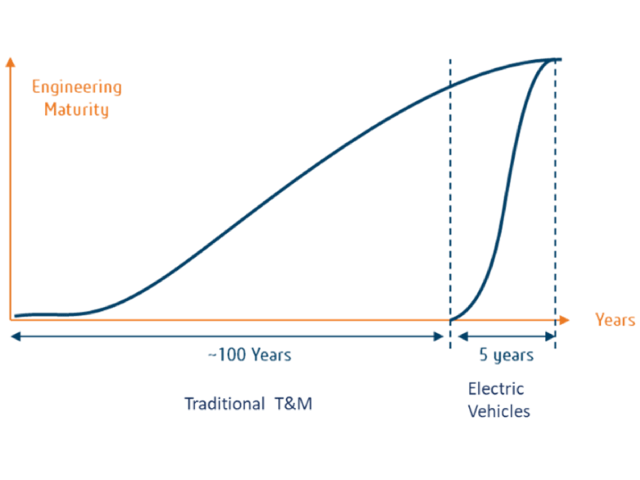
Moving from gasoline (or other combustible) to electric impacts the whole architecture and technologies of the vehicles, pushing to reengineer completely and do it fast!
Manufactures have to deal with a panoply of interdependency of systems such as batteries, HVAC, info entertainment, sensors, power electronics, powertrain that will ultimately affect the mechanical structure, body concepts and design.
Embedded software and infrastructure (gateways and antennae) ensuring connectivity are also integrating the development and manufacturing cycles.
Thus, new environment and more complexity are challenging the current state of mechanical centric development. For example, how an antenna electromagnetic fields will be interfering with other fields onboard systems and passengers?
In a nutshell, mass customization is the concept of achieving both customization and scale of economy (B. Joseph Pine II, 1999). In the current economy of experience, this definition is not enough as time to market and importance of quality are key factors.
In the experience economy, the crucial point is that the OEM could trigger and adjust the business processes based on its unique customer’s requirements (Push), from sales, procurement to engineering and manufacturing.
Because of continuously increasing product complexity, product variants and production variables, lead time and quality may be seriously challenged. Inadequate tools and manual processes will not be able to support the change. Processes will need to be digitized or, even better, automated and enhanced by artificial intelligence and integrated. A modern platform should enable the flow of information (Digital Thread), throughout the entire lifecycle of the product, from order to service.
In order to support fast development times and high quality, adoption of simulation technologies is critical. It minimizes costly physical tests and validates the interoperability of systems before any manufacturing takes place.
Quality, regulations and cost (QRC) are the elements of the equation that OEM in transportation and mobility, have to constantly solve by finding the right balance. From crash testing, to recyclability, recalls and now autonomous vehicles, complexity is just growing . Across the globe, governments are becoming stricter than ever on safety, emissions and recyclability. Not complying with legislation can result in very harsh penalties. Additionally, cities are simply banning — or will soon ban — vehicles that do not meet their own standards.
Transport and Mobility
What we do
We believe in digital simulation at every stage of product development and service, supported by the digitalization and automation of processes across the entire Product Lifecycle Management.
TECHNIA supports ground transportation engineering projects with advanced simulation and validation expertise.
We:
- Validate and optimize mechanical designs under varied requirements — from full vehicle body structures (cars, trucks, buses) to stiffness, rollover, and crash analyses.
- Correlate simulation results with physical testing in collaboration with certified crash test centre.
- Validate electronic components, electric motors and battery packs for vibration, shock, and fatigue performance.
- We anticipate and validate required standard tests upfront — reducing failed physical tests from full vehicle simulations to subsystem analyses such as seat pull tests.
Using advanced CAE technologies, we address one of the largest uncertainties in vehicle development: accurate load definition. Through multibody dynamics tools, we extract load histories from vehicle ride simulations to support reliable fatigue assessments.
Transport and Mobility
How we do it
We intervene at different stages to support new product development for ground transportation and mobility projects — from early concept validation to certification.
On the PLM side, we implement and support modern engineering processes within the 3DEXPERIENCE platform leveraging ENOVIA technology, ensuring digital continuity across disciplines.
On the simulation side, we virtually validate ground transportation products from concept trough to manufacturing.
At early design stages, we perform vehicle handling and load analysis using multibody dynamics (MBD) tools such as MSC ADAMS. Topology optimization — also known as generative design — is performed using using SIMULIA TOSCA to reduce weight while maintaining structural performance.
During product development, stress, vibration, and thermal analyses are carried out using SIMULIA ABAQUS to validate structural integrity and product performance. Design of experiments (DoE) and optimization using ISIGHT are applied when broader parameter exploration and performance trade off studies are required.
To address vehicle efficiency and comfort, we conduct CFD analyses using PowerFlow or 3DEXPERIENCE to evaluate drag and HVAC performance pushing optimization and innovation.
As designs mature, fatigue analyses using FE-SAFE verify durability and long-term reliability.
Once physical prototypes are built, we support experimental validation using strain gauges and reverse load identification for structure integrity Trough TRUE LOAD technology. This closes the loop between virtual and physical prototypes.
Finally, we simulate impact and crash scenarios using SIMULIA ABAQUS explicit dynamics solvers to support certification under FMVSS (or other) regulatory standards.